Image Showboat: The Life of Kobe Bryant
Image Michael Jordan: The Life
Image Magic: The Life of Earvin “Magic” Johnson
Image Jerry West: The Life and Legend of a Basketball Icon
Image Blood on the Horns: The Long Strange Ride of Michael Jordan’s Chicago Bulls

Roland's Notepad

Stuart Scott, 30 for 30, Jordan, and Locker Room Debates

Posted on 12.10.25

I didn’t know Stuart Scott, although I do remember having a fairly intense debate with him in the Chicago Bulls press room one day, during the 1990s when the Bulls and Jordan were ruling the NBA. That debate somehow happened despite how much I enjoyed his work on ESPN. I’m pretty sure it was on or around the morning after the 1995 Oklahoma City bombing because my friend Tex Winter would always wander down to the press room looking for the free newspapers that reporters would leave scattered about the room. I remember asking Tex what should be done with the bombers if and when they were caught. “String ’em up by the balls,” Winter, then in his mid 70s, replied defiantly.

April 1995 is a critical point, because Jordan had just returned a month earlier from his tenure playing baseball, and the Bulls were covered up with media. I can’t recall what ignited the debate with Stuart Scott (it did not involve Tex or his answer). I just recall Stuart being very upset with me and me trying to understand why. We were the only two people in the press room at that time, during practice, that day, and I came away sort of feeling that Stuart was upset about something else and he just sort of needed a debate partner.

I am thinking of this today because of the debut of ESPN’s 30 for 30 about his life and tragic death from cancer: “Boo-Yah: A Portrait of Stuart Scott,” Wednesday. As I recall I was probably in my third season of writing about the Bulls, was talking with someone else briefly (and likely said something that Stuart overheard and didn’t like). Like Jordan, Stuart was a UNC grad. And I was always what I’ve been, some guy from Wytheville, Virginia, accent and all (a sort of hillbilly heritage I have long treasured). By that time, I had spent a decade around the NBA, writing extensively about the Celtics, Pistons, Lakers, and the Bulls, so I was used to being around and interviewing high-profile players and coaches.

Still, it seemed absolutely surreal that I found myself engaged in a somewhat heated debate with an ESPN star, one who had a large cultural presence, somebody who was a major dude. Whatever the heated debate was about, it just sort of ended, probably because practice was over and neither of us wanted to lose any of the precious media interview time afterward. Stranger still, neither of us ever addressed the other again, at least not that I can recall.

I recall maybe encountering him in other media settings over the next couple of years and just nodding when we came face to face, no reason for hard feelings. It was just an unusual encounter. My only thought today is, RIP, Stuart. You will always be an all-time pioneer in sports media. I won’t apologize for allowing my ignorance to spark a debate with you. Rather, that surreal moment is something I’ll always treasure…

May the Fourth be with us all

Posted on 7.4.25

Sorry if this post offends some of my more ardently “patriotic” friends, but freedom wasn’t freedom until at least two centuries later than 1776.
Pick your own date on that one. Lincoln’s Emancipation Proclamation? Or the Supreme Court’s Brown Vs. The Board Of Education in the 1950s? Or the “ground-breaking” 1964 Civil Rights legislation?
The truth is, whatever freedom that was to be found came as a precious whisper at a time as it slowly dawned in the American mind.
The “founding fathers” clearly wrote and signed off on all that elevated language in the Declaration, but at the time and for centuries after it they were far from ready to live it.
Indeed, America was led by a long succession of men who did everything possible, high and low, enacted every sort of law, played every sort of demented game, to prevent Black people from acquiring any sort of power, be it education or a living wage or the slightest drop of prestige.
The sickness was beyond deep. The first European laws on this continent regarding very human Black people defined them as “chattel,” or farm animals.
I discovered that sad fact while writing part of a series about Blacks and the legal system for the Roanoke Times in the early 1980s.
Those laws served to unleash mass criminality. If you define people as sub-human then you are free to do sub-human things to them. Mass murder and rape and theft on an unimaginable scale, the sort of criminality that forms the absolute bedrock of the country today.
It is our legacy. Our truth.
It is why Black freedom, the freedom of all put-upon minorities, is the central story of American freedom itself.
Without those stories? We are merely a bunch of empty words.
I admit that as I became a man and gained a better understanding of our world that I began to feel a little different about the Fourth of July. It helped to explain all the strangeness I first became aware of as a child growing up in a small southern town.
Among my earliest recollections was that race came to weigh as a great mystery in my life. I was a small boy walking on Main Street with my father when he stopped to speak with a Black man named Mitch.
I am told that as a young child I had an imaginary native American friend called Kookiwah. It was apparently so intense that my mom had to set a place at the table each night for Kookiwah. Lol.
What was that all about?
Much later, as I went to school with and soon came to work with quite an array of amazing people, the mystery of race deepened.
I admit it would later become an obsession in my writing life and my research. Why was it like this?
Why was this country so desperate to cover up its true history? It was living history. We were living our racial history every single day and in absolute denial about it.
I have long considered that denial the number one issue of our culture, that it allowed us to be divided and then used to usurp our freedom.
Recent events show us that it is about to destroy us, if it hasn’t already.
There were many clues to these mysteries, but only in the five years of research for my latest book, a biography of Magic Johnson, did I find greater clarity on this issue.
A white writer from North Carolina in the 1880s, who had spent decades observing the behavior in the culture around him, wrote a story for the Atlantic describing the great scope of white fear driving the entire matter.
Sadly, it was the ability of certain politicians to exploit and manipulate white fear that allowed them to gain power and lead America down its needlessly ugly, murderous, rapacious path, through the entirety of slavery and the horrific decades that followed it.
As a young man, as I began to gain a better understanding of the world, that ugliness seemed to dissipate a little more each year over the decades.
I recall that it was in 1971 that I began as a relatively clueless young person to get the sense that things might be changing, whatever that meant.
I began to get the sense that for the first time in forever, Black people were finding the freedom to define freedom itself, that in fact the very idea of freedom itself was a sham if it did not address and embrace their long, painful, horrendous walk to free lives.
To live and be seen as equals. Or even better, to be recognized for the vast array of examples of their exceptionalism and superiority, that those qualities were far from exclusive to any race.
I based all of my feelings about race on personal experience.
Over the decades, at each step of the way, I found my life to be changed quite dramatically by any number of Black friends and mentors, people I have come to love dearly.
But I also soon enough became aware that no matter how successful or how brilliant or how deeply human they were, they always were possessed of a silent dread, that they had to be looking over their shoulder.
That white fear always lurked.
Now, over the past decade, for the first time in years, I feel that sense of foreboding is growing again.
I don’t know president Obama personally, but I even sense that about him these days. The ease and grace and skill with which he led this country have disappeared.
He’s had to begin looking over his shoulder. Seriously.
His ascension to the presidency did something to white people that I hadn’t seen or felt in a long, long time.
It brought out that somewhat dormant white fear.
Many people I know quickly came to despise him simply because he dared to lead the country with every ounce of talent, wisdom and ability he possessed. And he possesses immense amounts of those qualities.
So now, after years of having a sense that America was changing for the better, we find that our very definition of freedom has gotten really really crazy again.
We have a group of people, from the president to the supreme court, who simply don’t share many values with tens of millions of Americans.
The values of a majority of the Supreme Court are tied to the power of Donald Trump, a man obsessed with his own personal power, which is grounded in his ability to debase and weaken and destroy American democracy itself with its checks and balances.
What is his secret? He plays white fear like a master, with amazingly effective notes of resentment and grievance.
Now, we’re seeing racism become wildly systemic again, which has sickened me beyond belief to see white people I thought I knew rush to embrace it, to revel in it like they’ve been transformed from the decent folks I once knew into some sort of alien beings.
To me, the Fourth is not about all the gentlemen with the statues.
To me, there’s always been a lot of treachery perpetrated in the name of freedom. Right now that treachery is coming at us as a hurricane.
The Fourth has become a very serious day. It probably always was. I just didn’t recognize it.
To me, now it’s a day to reach into your heart and ask yourself, am I just celebrating my own freedom? Do I secretly enjoy the fact that millions of people more than ever have to look over the shoulder and wonder where their world is headed.
That ain’t freedom.
And if you think it is, you can go hell. Because if you persist, that’s where we’re headed.
Now more than ever I personally consider all of our Black cousins along with millions of other immigrant minorities and their powerful personal narratives as the true definers of American freedom.
If they ain’t free and protected by the Constitution, by those high-minded words…
Ain’t none of us free.

The Real Last Dance

Posted on 1.15.24

Looking back 25 years after Jordan’s final Championship

NOTE: Roland Lazenby spent the Last Dance season, 1997-98, with the Chicago Bulls and wrote a best-selling book about it, Blood On The Horns.

In 2020, my wife digitized the many cassette tapes of my interviews from 35 years of writing about pro basketball. In there was a gem I had never listened to, from an April 1991 game between the Washington Bullets and the Lakers. Jerry Krause, the Bulls GM at the time, had worked for both organizations as a scout and now some years later had come to the game in Washington in a moment of immense pride, to quietly show off a bit and perhaps even gloat. His Bulls were playing very well that spring and seemed on the brink doing great things.

A short, odd little fat guy—Michael Jordan had famously nicknamed him Crumbs for the evidence of his snacks often found on his shirts—Krause had spent years suffering ridicule while knocking around as a scout in pro basketball, a business of very large men. In the 1970s, Krause had finally reached what seemed like the pinnacle when he was named GM of the Bulls, only to be fired after a few weeks on the job. Like that, he had gone from a crowning achievement to immense public ridicule. If it seemed everybody in his hometown Chicago was laughing at him, that’s only because they were.

Yet by 1985, the Bulls were something of a laughingstock themselves, and financial whiz Jerry Reinsdorf was able to buy them for a pittance, about $14 million. Reinsdorf promptly stunned fans by hiring Krause to be his GM, and the short, little fat guy set about rebuilding the team. This time Krause had a vision, albeit an odd one. He wanted to hire a retired college coach, Tex Winter, who had long been the proponent of a quirky offense, the triangle, or triple-post. More important, Krause wanted to hire a young goofball named Phil Jackson as his head coach with the idea that Winter would mentor him to greatness. It would take a while to get Jackson in place, in part because he had written a memoir about playing for the Knicks in which he talked about taking LSD on the beach in California after New York defeated the Lakers for the 1973 NBA title. Nobody wanted to hire a coach who took LSD, but Krause paid the matter no mind. He had known Jackson for a decade and saw his odd genius.

Krause would also become excited about several players including a relatively obscure prospect out of Central Arkansas named Scottie Pippen. The Bulls struggled for some time to overcome the Bad Boy Pistons, but in that late April 1991 Chicago finally seemed on the way to doing that. Thus, Krause stood alone outside the Bullets locker room that night, seemingly waiting for reporters to notice him and interview him. I recall almost feeling sorry for him standing there and recorded about five minutes with him that night as Krause spoke grandly of his own work in assembling a team around the young superstar Jordan.

It was a conversation I had frankly forgotten until a quarter century later when it literally leapt out from that newly digitized archive.

Sure enough, Krause’s instincts had been spot on. It had all fallen in place for Jordan, Pippen, Jackson, Winter and their Bulls. They would win the ’91 championship, then five more over the next seven seasons. Listening to that tape of Krause at the brink of their greatness and knowing how it would all go from that early moment of his eager pride to a bad end, how all the happy days would evaporate in 1998 in a very public and dramatic ugliness, I was struck with an overwhelming sadness.

I later did an extensive interview with Krause on the tenth anniversary in 2008 when he told me he had videotape of every game played in the championship years. He had not viewed them even once, he told me with great bitterness.

That Last Dance

By that 1998 season, after so much success, the Bulls were caught in the throes of a non-sensical struggle for control of the team, with Jackson, Jordan and Pippen pitted against Krause, who announced before the season began that Jackson would not be allowed to return as coach in the fall of 1998.

“This is it,” Krause had said. “Phil and I know it. We all know it.”

In announcing his move, Krause did not identify exactly what had led to Jackson’s scheduled departure, but the relationship between the coach and GM had obviously turned from love and respect to hatred. The son of two fundamentalist preachers, Phil Jackson had been heavily influenced by the “rapture” or the idea of the end times. Thus, he always seemed to think in terms of the “last” this or that. He had dubbed the showdown with Krause “the Last Dance.” Later, as coach of the Lakers he would write a book about his battles with Kobe Bryant and call it the “Last Season.” It was a good name for the events in Chicago in 1998.

No matter where he played, the buildings virtually sparkled for Jordan that season. Each game, as he stepped onto the floor for introductions, he was greeted by the flashes of a thousand small cameras. The phenomenon was most brilliant at the United Center in Chicago, where the introductions would build to a crescendo of noise and light until Jordan’s name was called as the fifth starter, and the arena became a pulsating strobe. Later, at the opening tip, these same lights would again flicker furiously. But they were most maddening during free throws, when Jordan went to the line, and the rows of fans behind the basket would break into a dizzying twinkle, bringing to mind a mirror ball at a junior prom. In one of our several one-on-one interviews that season, I asked Jordan how he could possibly shoot free throws under the conditions, he smiled and replied, “I got used to that a long time ago.”

He had always been a superstar who understood and accommodated his fans. That was particularly true that spring, as indications grew that it could well be his last. The camera lights were by far the warmest measure of his popularity. Each time he made a spectacular play, Michael Jordan’s world glittered, a twinkling firmament of adulation that served as a backdrop for his every move. Despite all the trappings of the moment, my numerous conversations with Krause revealed that the GM was eager to end the Jordan era so that he could prove that he could rebuild the team without Jordan. I thought he was crazy.

I in turn went to Jordan to ask why they all couldn’t just sit down and talk out their differences. He replied that wouldn’t be possible because Krause had gotten in the way of winning too often. I realized then that Jordan was confident he would defeat Krause just as he had overcome the entire NBA.

Jordan was wrong, of course. He did not understand just how badly Jackson wanted to get away from Krause, that the coach would “ride off into the sunset” at the end of the season.
Jordan also couldn’t fathom that Jerry Reinsdorf—who had realized hundreds of millions in wealth with the growth of the Bulls by then—didn’t want to give Pippen a large contract, even though the forward had been underpaid for years and had been a magnificent player for the team.

As it sadly unfolded, Jackson would leave, Pippen would be traded, Jordan would retire, and Krause would fail miserably in his attempts to rebuild the team and eventually be fired. It would indeed prove to be the Last Dance for both Krause and Jordan.

I interviewed Krause extensively again in 2012. By then he had grown to accept everything that had come to pass. “It’s past history,” he said. “It’s done. Phil is a great coach. For a long time, he was very easy to work with. Then he was not so easy. That’s life. Things change. Phil is Phil. I’m proud I hired him.”
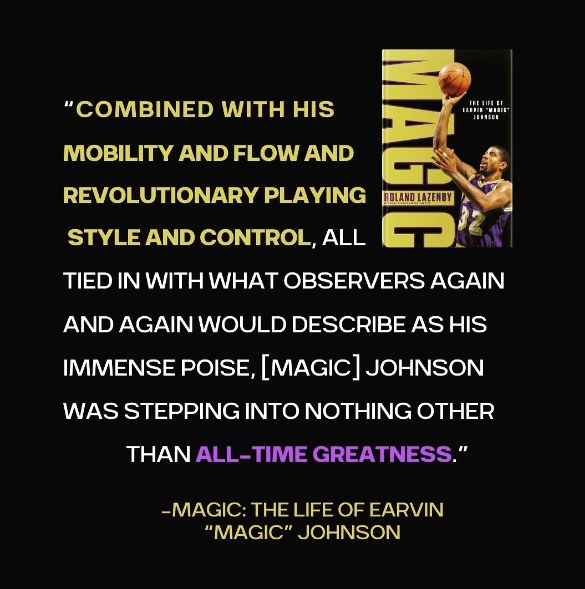
Roland on Glenn Clark Radio promoting Magic!

Posted on 10.26.23

Roland on JUNKIES promoting his new book Magic!

Posted on 10.26.23

Roland Lazenby has written more than five dozen nonfiction sports books, many of them about topics surrounding the Los Angeles Lakers, and his new one also fits that bill with a DC twist: it’s called “Magic: The Life of Earvin “Magic” Johnson,” and it’s on store shelves and online retailers as of Tuesday!

Lazenby called in to the Sports Junkies on Tuesday to discuss the book, which covers the life of the Basketball Hall of Famer and now minority owner of the Commanders – take a listen above!

Source: Audacy.com

The Good With the Bad

Posted on 10.24.23

The launch of my Magic Johnson biography arrives today and I and the launch are already in serious trouble. On Oct, 2, while helping my son move, I ruptured my quad, a horrific and gruesome knee injury that required surgery to reattach the thigh tendon to my knee. Rehab for a man my age could run as long as 18 months, but I’m hoping will clock in at somewhere around a year.

I am largely immobilized with a brace that runs almost the length of my leg. Somehow I’m going to hobble to a talk this evening at Book No Further, our fantastic independent bookstore here in Roanoke, Va., but all my plans and desires to appear at other locations, such as Lansing, Michigan, where Johnson grew up, are on hold until we get a sense of the landscape. Before you jump to sympathy for me, let me redirect the get-well wishes to wife Karen who bears the burden of an immobilized spouse. Fortunately, a goodly portion of launches has always involved radio interviews and now the all-important zooms. Meanwhile, I’m still scheming how to get out on the road and launch my Magic project the proper old-school way. I had my long-damaged right knee replaced in 2019 so at least I am familiar with the terrain. Cheers.